
How to Turn $1M+ of Corporate Wealth Into Personal Wealth More Tax-Efficiently
Exclusive Complimentary Fine Dining Session for Incorporated Physicians
Tax Savings & Corporate Wealth Transfer Conference for Physicians Only
Exclusive Event – Fine Dining Experience
August 1, 2026 (Saturday) · Toronto
August 2, 2026 (Sunday) · Toronto
August 15, 2026 (Saturday) · Vancouver
August 16, 2026 (Sunday) · Victoria
August 22, 2026 (Saturday) · Calgary

Tailored for Experienced Physicians
This exclusive event is designed for incorporated Physicians who want to reduce taxes, protect assets, and strategically grow their wealth.
Hosted by GT Wealth, a team of planners with over 100 years of combined experience, we proudly serve top 1% income earners across British Columbia, Alberta, and Ontario. As a leading one-stop firm in tax savings and corporate wealth transferring, we specialize in strategies that deliver measurable, lasting results.
Complimentary Fine Dining Session
What You'll Learn
Advanced planning ideas for incorporated physicians, including:
💼 Corporate Wealth Access
Are you paying unnecessary tax when accessing wealth from your corporation?
Explore planning ideas that may help you access corporate wealth more tax-efficiently for your personal financial goals.
📖 ITA 20(1)(e) & ITA 15(1)
Could ITA 20(1)(e) and ITA 15(1) create planning opportunities—or costly mistakes—when borrowing personally while using corporate assets?
Understand how these Income Tax Act provisions may affect certain financing and corporate wealth planning strategies.
🏡 Home, Retirement & Family Legacy
How can physicians access corporate wealth more efficiently for home purchases, retirement income, investment growth, and family legacy planning?
Explore planning concepts designed to align corporate wealth with your long-term personal and family objectives.
⚖️ The Risk of Action vs. Inaction
What are the risks of making changes, and what are the risks of continuing to do the same thing year after year?
Evaluate both the risks of changing your current structure and the risks of maintaining the same approach as your corporate wealth continues to grow.
Hear From Past Participants
Watch highlights and real conversations from past conferences — featuring Canadian Physicians just like you.
Case Study No. 1: Dr. Client
Below is a preview of the tailor-made 10-page Advice Memo for Dr. Client, outlining key issues, proposed solutions, legal structures, and second-stage opportunities. If you’d like a customized Advice Memo, book a complimentary 30-minute Zoom consultation with our relationship advisor for tailored insights.
Dr. Client spent decades building wealth. However, when the financial structure is not properly designed, multiples of $1,000,000 may quietly disappear through taxation. Dr. Client’s situation is a common case among high earning corporate owners who consult us to diagnose their financial structure.
1. Mortgage structure problem. Interest on a principal residence mortgage is not tax deductible under Income Tax Act s.18(1)(b) and the interest deductibility principles under s.20(1)(c).
If Dr. Client wants $1,000,000 personally to repay the mortgage, the corporation must distribute about $1,900,000 due to the approximately 48 percent tax on non eligible dividends. About $960,000 may be lost to tax before reducing the mortgage. Even after this cost, the mortgage interest remains non deductible because the borrowing relates to a principal residence rather than an investment.
2. Gradual withdrawal problem. Some advisors recommend withdrawing smaller amounts over time.
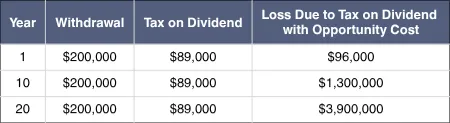
Dr. Client’s corporation earns about $1,000,000 annually and distributes about $200,000 in dividends plus a $150,000 salary. If $200,000 is withdrawn annually, this equals $4,000,000 over 20 years.
However, the larger loss is compounding. At 7 percent annual growth, the lost reinvestment may reach about $1.3 million by year 10 and about $3.9 million by year 20.
3. Some advisors recommend retaining funds inside the corporation. If Dr. Client retains about $500,000 annually, the corporation may accumulate roughly $10,000,000 over 20 years.
If this capital earns about 5 percent interest, passive income inside a corporation may face tax approaching 50 percent under the passive income regime governed by ITA s.123.3 and an additional dividend tax of about 48 percent may apply under s.82 and s.121. The impact may look like this:
In year 1, the shareholder may receive about $270,000 after tax, while paying approximately $12,000 in passive income tax and $240,000 in dividend tax. By year 10, the after tax value may reach about $3.2 million, with roughly $140,000 paid in passive income tax and $3.2 million in dividend tax. By year 20, the shareholder may receive about $7.7 million after tax, while total taxes paid may reach approximately $8.4 million. As capital grows, tax leakage grows with it.

4. Retirement withdrawal assumption. Some advisors suggest waiting until retirement.
Assume Dr. Client needs $200,000 after tax annually. With a personal tax rate around 40 percent, the corporation may need to distribute about $330,000 annually, creating about $130,000 of tax each year under the dividend taxation rules in ITA s.82 and s.121. Over 30 years of retirement, annual tax may be about $130,000, resulting in total tax of approximately $3.9 million.
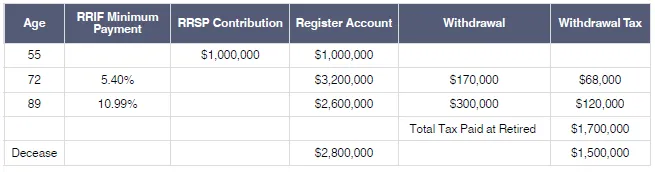
5. If funds remain in the corporation or RRSP or RRIF at death, deemed disposition rules apply under ITA s.70(5). Corporate assets may face multiple tax layers, and RRSP or RRIF may be treated as 100 percent taxable income. Even when withdrawals are delayed, tax leakage does not disappear. It spreads across decades, creating about $1,600,000 tax during retirement and another $1,500,000 at the estate level, totaling about $3,200,000.

Solutions

RRSP with Corporate Income Hedging and Interest Meltdown
Under Subsection 89(1) of the Income Tax Act (ITA), allow funds to grow within the company tax-efficiently and transfer them out through a Capital Dividend Account.
Under Paragraph 20(1)(c) of Income Tax Act, applying for an investment loan to create deductible interest expenses against annual income, as an alternative to making new RRSP contributions.
The above strategies can lower the tax by $2 million.

Under Section 148 of the Income Tax Act, the tax-exempt account allows for tax-deferred growth. By re-allocating $500k for 10 years into a tax-exempt account, the client could accumulate $20M by retirement.
Assign the policy to a third-party lender to secure a personal loan based on the cash value. Loan proceeds are received without triggering immediate tax, saving on $6 million taxes incurred on yearly cash flow.

Legal Document Coordination: Corporate Restructuring , Wills, Corporate Will.
✅ Corporate restructure with proper Opco and Holdco inter-company setup for $1 million tax defer transactions.
✅ Will: provides a foundational step in estate planning and ensures a seamless estate transfer, avoiding unnecessary delays and costs.
✅ Corporate Will: While Alberta has minimal probate cost, it's highly advisable to include a corporate succession plan in your Will for smooth business transition and continuity.
Additional Key Strategies to Be Reviewed After Above Priorities Are Addressed...

✅ Intergeneration Tax Saving Plan (ITSP)

✅ Alter Ego/Joint Partner Trust

✅ Estate Freeze
Tax Savings & Corporate Wealth Transfer Conference for Physicians Only
Exclusive Event – Fine Dining Experience
August 1, 2026 (Saturday) · Toronto
August 2, 2026 (Sunday) · Toronto
August 15, 2026 (Saturday) · Vancouver
August 16, 2026 (Sunday) · Victoria
August 22, 2026 (Saturday) · Calgary
🎥 Real Questions From Canadian Physicians
Tax Savings & Corporate Wealth Transfer Conference for Physicians Only
Exclusive Event – Fine Dining Experience
August 1, 2026 (Saturday) · Toronto
August 2, 2026 (Sunday) · Toronto
August 15, 2026 (Saturday) · Vancouver
August 16, 2026 (Sunday) · Victoria
August 22, 2026 (Saturday) · Calgary
Advanced Tax & Wealth Planning Insights for Physicians
Our expert speaker will provide actionable insights on the relevant sections of the Income Tax Act to help you achieve targeted wealth creation and tax savings — ranging from millions to tens of millions.
✅Income Tax Act s. 15(1)
Use corporate assets to reduce tax when repaying a personal mortgage or acquiring personal property.
✅ITA s. 20(1)(c)
Transfer corporate assets to personal hands with a 50% tax offset and reduce passive income taxed at 50% to retain capital.
✅ITA s. 148
Withdraw RRSP/RRIF tax-efficiently; implement a self-insured retirement plan to minimize 50% tax and a 15% government claw back.
✅ITA s. 138.1
Invest through Canada, U.S., Europe, and Asia sector funds with 2–3× returns (2014–2024) and optional principal guarantees.
✅Income Tax Act s. 85
Transfer shares to family without immediate tax; mitigate deemed disposition capital gains tax of 25% at the estate.
✅ITA s. 104
Use trust structures to safeguard assets against mismanagement and protect from relationship breakdown.
✅ITA s. 73(1.01)
Transfer assets to an alter ego trust to avoid 5% probate fees and reduce the risk of family disputes.
📸 Gallery: Our Recent Event







📸 Gallery: Our Recent Event
Limited-Time Offer
Be Among the First 5 Confirmed Physicians to Register and Attend Complimentary. Your Experience Includes:
Fine Dining – Enjoy a premium three-course meal of your choice.
Exclusive – Reserved exclusively for physicians and their partners.
$500 Value Advice Memo – A personalized initial planning report tailored to your selected areas of interest.
Presented By – One of Canada's leading high-net-worth wealth planning speakers.

FOLLOW US


